
How to Choose a Commercial Display Cabinet for the European Market: A 2026 Buyer's Guide to Compliance and Selection Writter: Terry Qi
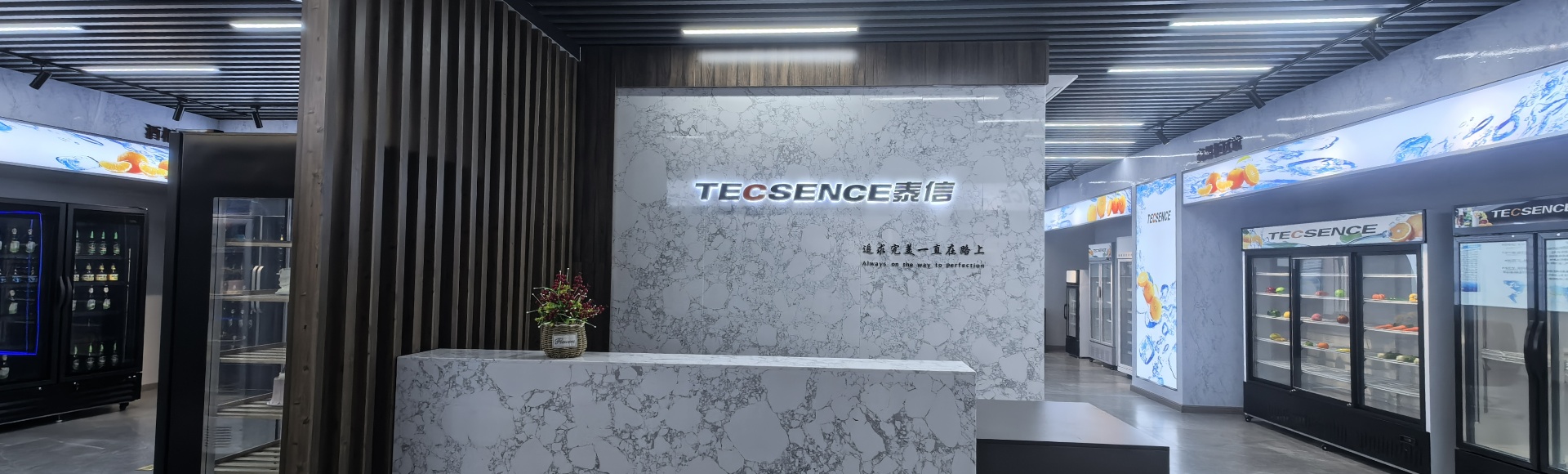
By Qingdao Tecsence Cold Chain Co., Ltd.
For a European retailer, distributor, or HoReCa buyer, a commercial display cabinet is not a commodity you pick on price. It is a fixed asset that sits in your store for years, holds temperature in a regulated market, carries your brand on its glass, and quietly shapes your energy bill. Choosing well means passing two gates: compliance (can it legally and reliably operate in Europe?) and selection (does the specific model fit the scene?). This guide walks through both.
Part 1 - Compliance: the entry ticket to the European market
In Europe, a cabinet that looks right but fails compliance is a liability, not a bargain. Three areas decide whether a unit belongs on your floor.
1. Refrigerant and the F-Gas direction
The EU F-Gas Regulation is steadily pushing the industry away from high-GWP synthetic refrigerants toward low-GWP natural alternatives. For commercial refrigeration, that means R600a (isobutane) and R290 (propane) have become the default engineering choice rather than a premium option. When you specify a cabinet, ask the refrigerant first - a platform built on R600a/R290 is already aligned with where European rules are heading, which protects your investment from future redesign or recall risk.
At Tecsence, the entire upright display range runs on R600a/R290 as standard, at 220-240 V / 50 Hz.
2. Energy labeling (ERP) and EPREL registration
Before a refrigeration product is placed on the EU market, it must carry the correct energy label under the ERP framework and be registered in the EPREL database. For a buyer, this is practical due diligence: request the energy class and the supporting test report for the exact model you intend to purchase.
We are transparent about where our range stands: selected models reach energy Class B, and we supply the corresponding ERP test report per model rather than quoting a single number across the catalogue. If your tender or procurement spec demands a specific class, tell us the target and we will match it to the right SKU and documentation.
3. Climate Class - the spec most buyers overlook
Climate Class defines the ambient temperature and humidity a cabinet is designed to handle. It is the difference between a cabinet that performs in a calm, air-conditioned supermarket and one that struggles at the back of a warm, busy kitchen.
- Class 3 (25 °C / 60% RH) suits temperate, climate-controlled retail.
Qingdao Tecsence Cold Chain Co., Ltd. | Page 2
- Class 4 (30 °C / 55% RH) covers warmer sales floors and light back-of-house.
- Class 5 (40 °C / 40% RH) is built for hot, demanding environments such as kitchens and tropical
zones.
Specify the climate class your site actually requires, and confirm it per model. Choosing below your real environment is the fastest route to condensation, cooling loss, and unhappy customers.
Part 2 - How to choose: five dimensions that matter
Once compliance is settled, selection comes down to five practical dimensions.
1. Cooling system and refrigerant discipline
Frequent door openings in a retail or HoReCa setting cause constant heat and humidity exchange. A cabinet sized for a calm walk-in cooler will not survive it. Look for a professional refrigeration configuration: natural low-GWP refrigerant, a compressor matched to high-load duty, a proper defrost system, thick insulation, and anti-condensation glass that stays clear. These are the features that keep a 24/7 cabinet stable instead of fogging, frosting, or drifting out of range.
2. Glass and presentation
The glass is the selling surface. Low-E (low-emissivity) coated glass cuts radiant heat transfer, which lowers energy draw and reduces condensation. A frameless door (our PRO line) removes visual obstructions for a cleaner, more premium look. And for frozen applications, heated glass is what defeats frost on a cabinet running at -25 °C to -18 °C - without it, an ice-cream freezer is a fogged-up box.
3. Match the series to the scene
A "one cabinet fits all" mindset leads to compromised performance. The modern range splits into purpose-built forms:
- Beverage & dairy (Classical, +1 °C to +10 °C; Beverage series such as JC-800 / JC-1400) -
the everyday chilled merchandiser for drinks, yogurt, and milk.
- Back Bar (BC series) - built for hospitality, fitting behind the bar where bottles and cans are
served.
- Sub-zero beer chiller (-6 °C to 0 °C) - keeps beer and specialty drinks at serving temperature
without freezing.
- Display Freezer with heated glass (-25 °C to -18 °C) - for ice cream and frozen novelty, visible
and frost-free.
- Medical cabinet (YLPC, 2-8 °C / 8-20 °C) - stable storage for pharmacies and clinics.
- Eco Upright (PC series) - the efficiency-focused line for cost-conscious deployments. Each solves a specific shelving problem instead of approximating all of them.
4. Certifications, complete
Qingdao Tecsence Cold Chain Co., Ltd. | Page 3
For European market access, certifications are not decoration. A credible supplier should be able to show CE, CB, NSF, ETL, RoHS, and management-system certificates ISO 9001 and ISO 14001, across the range - not just on a flagship unit. Ask for the certificate pack per series before you commit volume.
5. Manufacturer backing and serviceability
A display cabinet is a long-lived asset; the relationship with the maker matters. Work with a manufacturer that offers OEM and ODM programs - color, logo, light box, and energy profile all customizable - so the cabinet carries your brand as readily as ours. Confirm response commitments and spare-part discipline up front, because a cabinet down for a week is revenue down for a week.
Part 3 - A note on private label and OEM
If you are a distributor or operator building your own brand, the cabinet is also a canvas. Because our OEM/ODM programs are fully open, the same certified, R600a/R290 platform can ship as your private-label unit, with the documentation (energy reports, certificates, EPREL registration) assembled for your market. That turns a purchase into a branded product line.
Closing
Tecsence builds commercial display cabinets on a single refrigeration foundation - roughly 93 SKU across 10 series, all on natural refrigerant, all at 220-240 V / 50 Hz, all certified to CE, CB, NSF, ETL, RoHS, ISO 9001 and ISO 14001. From the Classical merchandiser to the PRO frameless Low-E line, the Sub-zero beer chiller, the heated-glass display freezer, the Back Bar, the Eco Upright, and the medical cabinet - the question is rarely "which cabinet" in the abstract, but "which cabinet for this scene, compliant for this market."
If you are specifying display cabinets for Europe in 2026, start with the compliance gate, then match the series to the shelf. We are happy to supply the per-model energy reports, certificate packs, and climate-class confirmations you need to make the call.
Qingdao Tecsence Cold Chain Co., Ltd. - "Always on the way to the perfection."
Contact Us
Tel: +86-18953281611
Email: jim.cheng@Tecsence.com
Add: No.3,Zhenshui 2nd Road, Jimo, Qingdao, Shandong, PRc

 +86-18953281611